If you often hear yourself saying, “How many times do I have to ask?” you are not alone. Many parents repeat the same instructions all day, especially during busy mornings, mealtimes, and bedtime. Learning how to get your child to listen is less about speaking louder and more about making directions clear, getting their attention, and building predictable routines. These strategies can reduce power struggles while teaching children what cooperation looks like.
With a few simple changes, you can make everyday instructions easier for your child to understand and follow. It also helps create a calmer home environment where children know what to expect. Most importantly, these approaches can strengthen your connection with your child while encouraging better listening habits over time.
Table of Contents
Why Children May Not Listen the First Time
Children do not always ignore directions on purpose. A child may be absorbed in play, tired, hungry, distracted, or still developing the skills needed to process what you are saying.
It helps to separate “won’t” from “can’t.” If your child does not understand a long instruction, repeating the same words will not solve the problem. Clear, age-appropriate directions work better.
7 Ways to Get Your Child to Listen Without Repeating Yourself
1. Get Your Child’s Attention First
Before giving an instruction, move closer and make sure your child is listening. Say their name, get down to their level, and pause a competing distraction if you can.
Instead of calling from the kitchen, “Put your shoes away!” walk over and say, “Sam, look at me. Please put your shoes by the door.” Getting attention first gives your child a better chance to understand.
The CDC recommends getting a child’s attention before giving a direction, including moving close and using the child’s name. (CDC)
2. Give One Clear Direction at a Time
Young children can struggle to remember several instructions at once. Keep your direction short and specific.
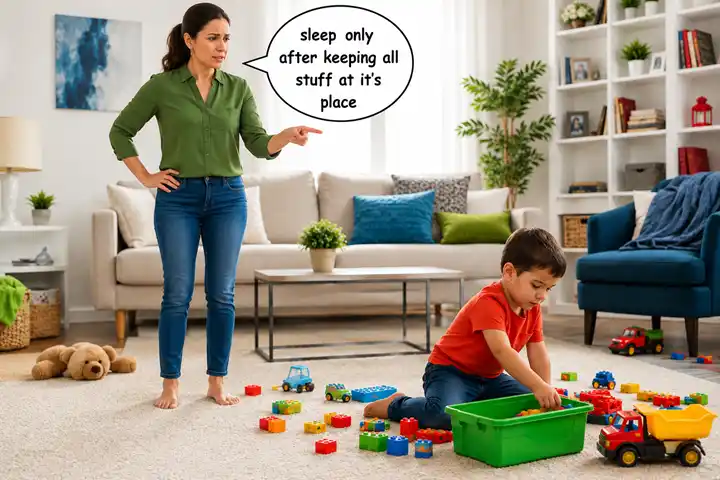
Instead of saying, “Clean your room, put your pajamas on, brush your teeth, and get into bed,” break it down: “Please put the blocks in the box.” Once that is done, give the next instruction.
A clear direction tells your child exactly what you want them to do. This makes it easier for them to understand what is expected and respond successfully.
3. Tell Your Child What to Do
Whenever possible, describe the behavior you want instead of only saying what you do not want.
Try “Please walk inside” instead of “Don’t run.” Say “Use gentle hands” instead of “Stop hitting.” Tell your child “Put the crayons in the box” rather than “Quit making a mess.”
Positive, specific directions give children a clear action to follow and reduce guessing. They also make it easier to get your child to listen.
The CDC notes that specific directions tell children exactly what behavior you expect rather than simply telling them what not to do. (CDC)

4. Offer Two Acceptable Choices
Children often want some control over what happens next. When there is flexibility, offer two choices that both work for you.
You might say, “Do you want the blue pajamas or the green pajamas?” Choices should not be used for non-negotiable safety directions. For ordinary routines, small choices can encourage cooperation.
For example, you might say, “Would you like to put your toys away before your snack or after your snack?” Either option still moves the routine forward.
5. Build Routines Around Repeated Tasks
If you find yourself giving the same reminders every morning, let a routine do some of the talking. A simple visual checklist can help children remember what comes next.
A morning routine might be: get dressed, eat breakfast, brush teeth, put on shoes, and grab the backpack. Bedtime might include pajamas, brushing teeth, a story, and lights out.
Predictable routines help children know what to expect, while consistency makes expectations easier to learn. Over time, routines can reduce repeated reminders.
A predictable routine can make everyday instructions easier for toddlers to follow, as explained in our guide to daily routines for toddlers.
6. Praise Your Child When They Listen
Do not wait for difficult behavior to give your child attention. Notice cooperation when it happens.
Try specific praise such as, “You put your shoes away the first time I asked. Thank you for listening,” or “You stopped playing and came when I called you.”
Specific praise tells children exactly which behavior you liked. It can make positive behavior more likely to happen again.
This approach fits well with positive parenting, which focuses on encouragement, respectful guidance, clear boundaries, and communication.
7. Give the Direction Once, Then Follow Through Calmly
If you repeat an instruction several times before acting, your child may learn that the first request is optional. Instead, give a clear direction, allow a reasonable moment for your child to respond, and then calmly follow through.
For example: “The tablet goes away now.” If your child continues playing, move closer and calmly remind them of the agreed consequence or help them complete the transition.
Following through does not mean yelling or threatening. It means doing what you said you would do. Consistency and calm follow-through help children understand that limits are real.

What to Avoid When You Want Better Listening
Constantly increasing your volume can turn listening into a waiting game: the child learns that the instruction does not really matter until the parent is shouting. Repeating long explanations can also make the message harder to follow.
Avoid giving directions while your child is highly distracted, stacking several commands together, or using vague phrases such as “Be good.” Instead, say what you want, keep it realistic for your child’s age, and give them a chance to respond.
Do not expect perfect cooperation every time. Children are still learning self-control, transitions, and communication. The goal is steady progress.
Clear, respectful communication is an important part of helping young children understand what you expect from them.
When to Look for Extra Support
If your child regularly seems unable to hear or understand simple directions, struggles with communication, or has difficulties across settings, discuss your concerns with their pediatrician or another qualified professional.
An occasional “ignore” during exciting play is different from consistently struggling with age-appropriate directions even when you have their attention.
Frequently Asked Questions
How can I get your child to listen without yelling?
Start by getting close, saying their name, and giving one clear direction in a calm voice. Then give them a reasonable opportunity to respond and follow through consistently if they do not.
Should I make my child repeat the instruction?
You can occasionally ask your child to tell you what they heard, especially when the instruction is important. This can help you check understanding rather than assuming that silence means defiance.
What if my child says “no” every time?
Stay calm and acknowledge the feeling without removing the limit. You might say, “I know you want to keep playing. It is time to put the toys away.” If possible, offer a small choice within the limit.
Can routines help you get your child to listen?
Yes. Predictable routines reduce the number of decisions children have to process and make everyday expectations more familiar. A visual routine can be especially useful for younger children.
Conclusion
Learning how to get your child to listen is a process, not a one-day fix. Start with the basics: get their attention, give one clear direction, describe what you want, offer choices when appropriate, use predictable routines, praise cooperation, and follow through calmly.
When you make these habits consistent, you may find that you no longer need to repeat every request. More importantly, your child is learning to understand expectations and become more independent. These habits can help you get your child to listen with less frustration.
Author’s Note
TheParentingPedia.com creates evidence-informed parenting content designed to give parents practical, realistic strategies. This article is for general educational purposes and is not a substitute for individualized advice from a pediatrician, child-development specialist, or other qualified professional.
Sources & Further Reading
- Raising Children Network — Tips to help kids follow instructions and cooperate
- CDC — Steps for Giving Good Directions
- CDC — Tips for Relying on Routines and Rules
- CDC — Tips for Praise, Imitation, and Description

TheParentingPedia editorial team creates practical, research-informed parenting content to help parents navigate everyday challenges, child development, behavior, and family life. Our articles draw on reputable parenting and child-development sources and are reviewed for clarity, accuracy, and practical usefulness.