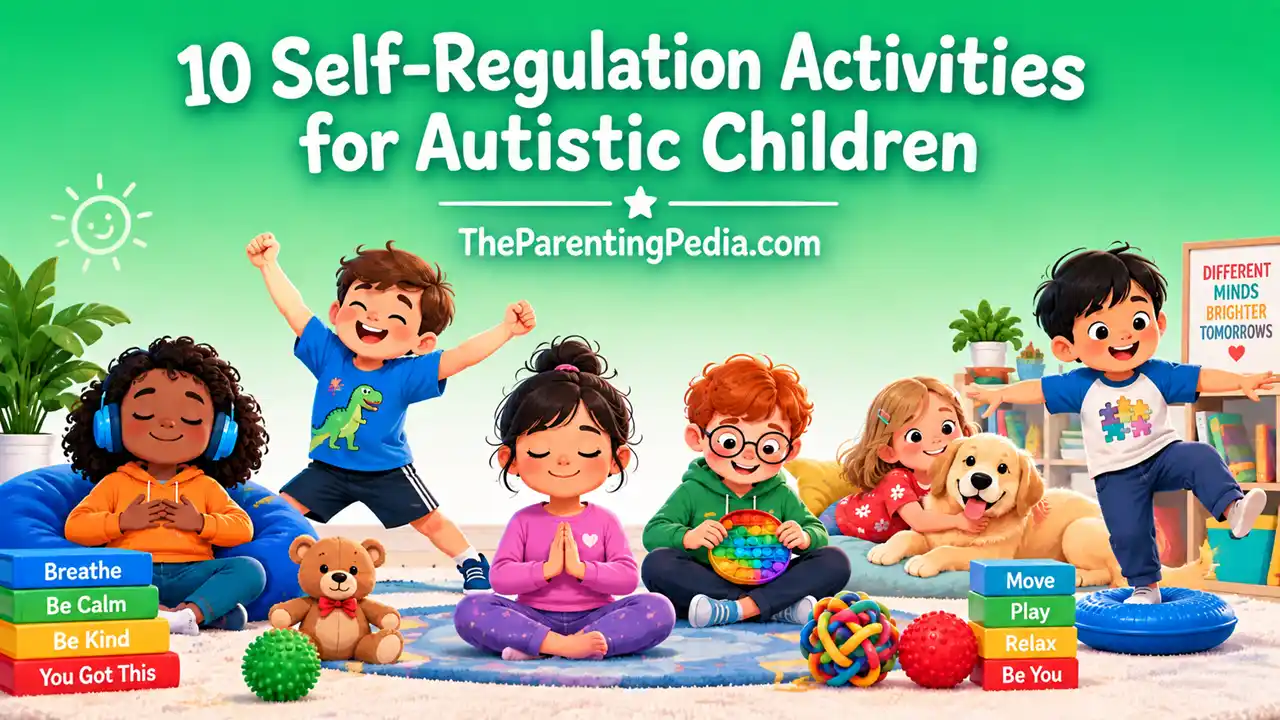
Helping an autistic child manage big emotions, sensory overload, and everyday stress can sometimes feel challenging. But with the right support, children can gradually learn what helps them feel calmer and more in control.
In this guide, discover 10self-regulation activities for autistic children that parents can easily try at home—and find out which activities may best suit your child’s individual needs.
Table of Contents
What Does Self-Regulation Mean for an Autistic Child?
Self-regulation means noticing emotions and body signals and using strategies that support comfort and participation. For autistic children, sensory processing can be an important part of this.
Some children are sensitive to sounds, lights, touch or movement, while others seek more sensory input. Needs can change with stress, tiredness and surroundings. (National Autistic Society)
The goal is not to make an autistic child appear “normal” or stop harmless stimming. It is to help the child feel safe, communicate needs and participate.
10 Self-Regulation Activities for Autistic Children
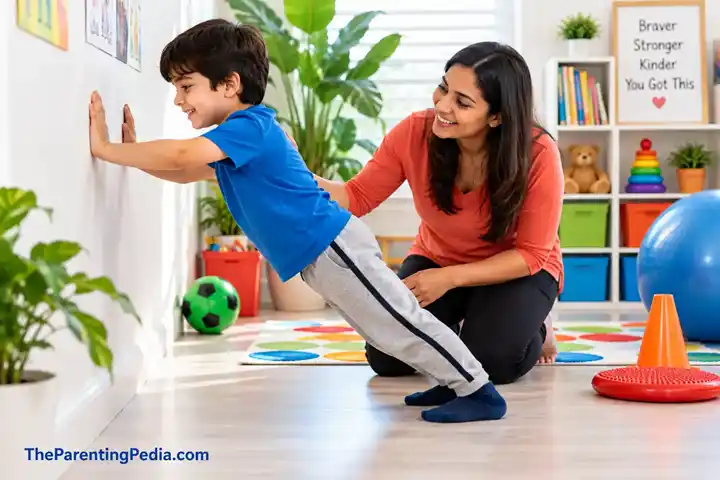
1. Wall Push-Ups
Ask your child to stand facing a wall, place both hands against it and gently push. Try a few repetitions, then let your child decide whether to continue.
The National Autistic Society includes wall pushes among examples of muscle-work activities used within sensory circuits. (National Autistic Society)
2. Animal Walks
Try bear walks, crab walks, frog jumps or another movement your child enjoys. These can provide movement, coordination and body-awareness opportunities while making a useful short break between activities.
Keep it playful rather than turning it into an exercise test. If your child dislikes a movement, offer another choice.
3. A Calm Movement Break
A short break might include walking, stretching, dancing or playing with a ball.
For more ideas on responding calmly when children become resistant or frustrated, read our guide on how to handle a stubborn child calmly.
4. Carrying Safe, Lightweight Items
Turn movement into a simple household job, such as carrying cushions or lightweight books.
Avoid heavy loads or an unsupervised “heavy work” programme. Ask a professional about appropriate activities if your child has physical or medical concerns.
5. Resistance-Band Pulling
If your child enjoys resistance activities, a light exercise band can provide controlled pulling. Supervise closely, never wrap the band around the child, and stop if there is pain or discomfort.
An occupational therapist can help select activities for children who need a specific sensory-motor programme.
6. Gentle Swinging or Rocking
Some autistic children enjoy predictable movement such as gentle swinging or rocking. Others find movement uncomfortable.
If your child enjoys a swing, keep the movement slow and predictable. Stay close and watch for signs that the child wants to stop. Swinging may help some autistic people but is not suitable for everyone. (National Autistic Society)
7. Create a Quiet Regulation Space
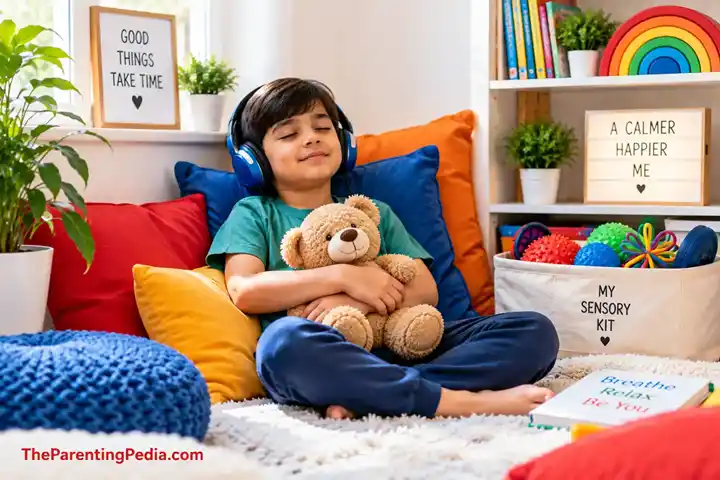
A quiet corner can give your child somewhere to reduce sensory input when the environment becomes too busy.
If your child frequently experiences worry or fear along with emotional difficulties, our guide to child anxiety symptoms may also be helpful.
8. Breathing With Finger Tracing
Ask your child to slowly trace around one hand with a finger. They can breathe in while moving up a finger and breathe out while moving down. Repeat around the hand if comfortable.
Raising Children Network describes finger-tracing breathing as a possible relaxation exercise for autistic children. (Raising Children Network) During intense distress, however, reducing demands and providing calm support may be more appropriate than asking for a breathing exercise.
9. Sensory Box or Fidget Choice
Create a small box containing a few items your child already likes, such as a fidget toy, soft fabric or drawing materials.
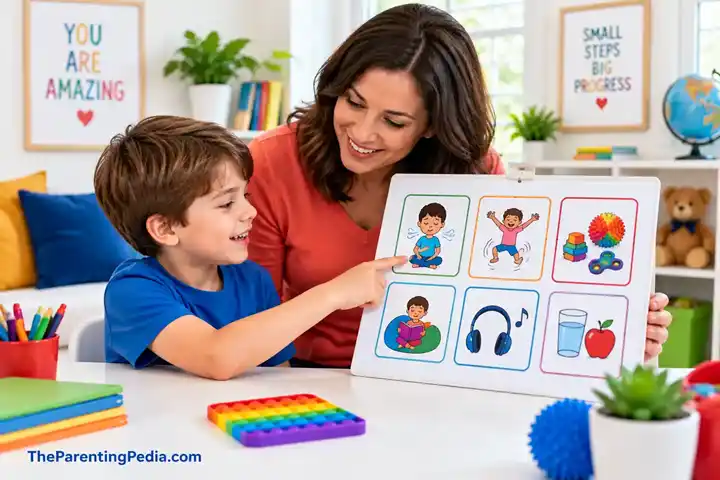
10. Emotion Scale and Break Card
A simple visual scale can help a child communicate how intense their feelings are:
- Green — “I feel okay.”
- Yellow — “I need help.”
- Red — “I need a break.”
How to Know Which Activity Helps
There is no universal list of self-regulation activities for autistic children that works for everyone. Watch what happens before and after an activity.
Ask:
- Does my child seem calmer or more comfortable?
- Did the activity increase distress?
- Does my child choose it independently?
- Are particular sounds, textures or situations common triggers?
A simple activity diary can help you record which self-regulation activities for autistic children were offered, the situation, and the response.
Let your child choose what feels helpful. The National Autistic Society notes that some autistic people use sensory kits or boxes to gather items that help them manage their sensory experience. (National Autistic Society)
What Parents Should Avoid
Regulation support should never be used to force a child to behave in a particular way. Avoid using sensory activities as punishment or insisting on an activity the child clearly dislikes.
Be cautious with weighted blankets, weighted vests, deep-pressure techniques and specialised equipment. Discuss these with an appropriately qualified professional when needed.
When Professional Guidance Can Help
Consider talking with a pediatrician, occupational therapist or another qualified professional when sensory or regulation difficulties regularly affect sleep, eating, school, communication, safety or family life.
If your child also shows ongoing worry, fear, or emotional distress, you may find our guide on child anxiety symptoms helpful.
For more positive approaches to setting boundaries, see our guide on how to discipline a child without beating.
Frequently Asked Questions
What are self-regulation activities for autistic children?
Self-regulation activities for autistic children are practical strategies that may help a child manage sensory input, emotions, attention or energy. Examples include movement breaks, quiet spaces, breathing exercises and visual supports.
Should I make my autistic child do a sensory activity?
No. Offer choices and watch your child’s response. An activity that helps one child may be uncomfortable or overwhelming for another.
Can stimming help with self-regulation?
Yes. Some autistic people use repeated movements, sounds or sensory actions to manage sensory experiences or emotions. Harmless stimming does not automatically need to be stopped.
Are sensory activities a treatment for autism?
These activities should not be presented as a cure for autism. Some may help an individual child manage sensory needs or participate more comfortably, while specialised interventions should be discussed with qualified professionals.
When should I speak with an occupational therapist?
Consider professional guidance when sensory differences consistently affect everyday activities, learning, communication, safety or wellbeing. An occupational therapist can help assess individual needs and suggest appropriate adaptations.
Conclusion
Self-regulation activities for autistic children work best when they are flexible, respectful and based on the individual child. Start with one simple strategy, observe the response and give your child a genuine choice to continue or stop. Over time, you can build a small set of self-regulation activities for autistic children that your child actually prefers.
The aim is not to eliminate autistic behaviours or make every child respond in the same way. It is to help children understand their needs, communicate when they need support and access safe strategies that make everyday life more manageable.
Author’s Note
This article is written for parents and caregivers seeking practical, evidence-informed strategies to support children’s emotional and sensory regulation. It is intended for general educational purposes and does not replace individualized advice from a qualified healthcare or occupational therapy professional.
Sources & Further Reading
- National Autistic Society — Autism and sensory processing. (National Autistic Society)
- National Autistic Society — Ten simple sensory strategies for autistic children. (National Autistic Society)
- Raising Children Network — Emotional development and regulation for autistic children. (Raising Children Network)
- Raising Children Network — Visual supports and schedules for autistic children. (Raising Children Network)
- NHS Leicestershire Partnership — Strategies for supporting sensory processing needs. (Leicestershire Partnership NHS Trust)

TheParentingPedia editorial team creates practical, research-informed parenting content to help parents navigate everyday challenges, child development, behavior, and family life. Our articles draw on reputable parenting and child-development sources and are reviewed for clarity, accuracy, and practical usefulness.