

Balancing work responsibilities, household tasks, and children’s needs can feel challenging for any parent. A practical Work-Life Balance as a Parent is not about dividing every hour perfectly between work and family. It is about creating realistic routines, setting healthy boundaries, sharing responsibilities, and making meaningful time for the people you love.
Teaching children age-appropriate responsibilities can also make family life more manageable while helping them develop confidence and independence. For practical ideas, see our guide on Healthy Family Boundaries.
Table of Contents
10 Practical Ways to Improve Work-Life Balance as a Parent
1. Decide What Matters Most
Identify your family’s main priorities, such as school mornings, shared meals, bedtime, important work deadlines, or one-on-one time with your children.
Choose three or four priorities rather than creating a huge list. When everything feels urgent, it becomes harder to focus on what matters.
2. Create a Simple Weekly Plan
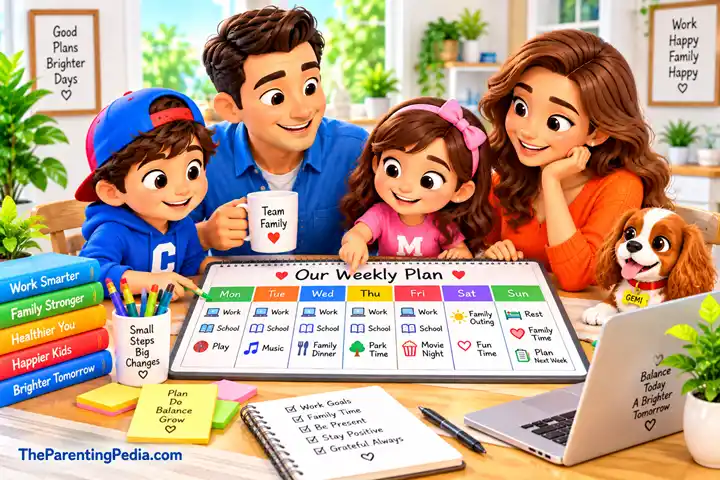
Use one shared calendar for work commitments, school activities, appointments, meals, homework, and family activities.
Keep some open space. Children get sick, meetings run late, and plans change. A schedule should guide your family rather than control it.
3. Set Clear Work Boundaries
If you work from home, create a clear beginning and ending to your workday whenever possible. Turn off non-essential notifications during important family moments.
Work-Life Balance for Parents becomes easier when work has reasonable boundaries. If your job has irregular hours, explain your schedule to your children in an age-appropriate way.
Japan has also highlighted flexible work styles and childcare support as ways to help parents combine career development with raising children.
4. Share Household Responsibilities
One parent does not need to manage every household task. Discuss who will handle meals, shopping, laundry, school preparation, cleaning, and children’s routines.
Children can also help with age-appropriate chores. Sharing responsibilities teaches practical skills while reducing the workload carried by parents.
5. Protect Small Moments of Family Time
You do not need several free hours every day to connect. Ten focused minutes can be meaningful when you put your phone away and listen.
Try breakfast together, an after-school conversation, reading before bed, or a short evening walk. HealthyChildren.org highlights regular family routines and shared activities as useful parts of family life.
Making room for unstructured time can also benefit children, so see our guide on The Importance of Free Time for Kids for more ideas.
Families also need time and support to balance caregiving with work responsibilities, as UNICEF explains in its guidance on support for parenting.

6. Use Routines to Reduce Daily Stress
A predictable morning and evening routine can remove many small decisions from a busy day. Children can pack school bags the night before, choose clothes in advance, and follow the same basic bedtime sequence.
Routines should be flexible rather than rigid. Raising Children Network recommends routines that are planned, clear, regular, and predictable while still allowing free time.
Families with younger children can also explore our guide to creating a simple and predictable Daily Routine for Toddlers.. Learn to Say No
Parents often feel pressure to accept every invitation, school activity, work request, or social commitment. Saying yes to everything can leave little time for rest or family.
Before accepting another responsibility, ask whether it is necessary, whether someone else can help, and whether it fits your priorities. A respectful “not this time” can protect your family’s schedule.
8. Make Self-Care Part of the Routine
Self-care does not have to mean an expensive outing or several hours alone. It might be reading for 15 minutes, talking with a friend, exercising, praying, meditating, or getting enough rest.
Taking reasonable time to recharge can make it easier to be patient and present. The American Academy of Pediatrics notes that parents also benefit from having time for themselves.

9. Be Present Instead of Perfect
Children do not need a parent who gets every decision right. They need connection, attention, consistency, and reassurance.
If you have a difficult day, reconnect with your child and start again tomorrow. A short conversation, hug, story, or shared laugh can matter more than completing every item on your list.
10. Review and Adjust Your System
Work-Life Balance for Parents changes as children grow. A routine that works for a preschooler may not work after your child starts school or develops new interests.
Every month, ask:
- What is working?
- What is creating stress?
- What can we stop doing?
- What can we share?
- What deserves more family time?
How to Handle Busy or Difficult Weeks
During busy periods, lower the standard from “perfect” to “good enough.” Focus on essentials such as meals, sleep, school or work responsibilities, needed appointments, and emotional connection. Non-essential chores can wait.
If you have a partner, discuss the temporary workload openly. If you are parenting alone, consider whether a trusted relative, friend, neighbour, or childcare option can provide practical support.
Small adjustments can protect Work-Life Balance for Parents during demanding periods without requiring a complete change to family life.
Teaching Children About Balance
Children learn from what parents do. When they see adults setting boundaries, sharing responsibilities, taking breaks, and making time for relationships, they begin to understand that work and family both have a place in life.
Give children age-appropriate responsibilities and let them participate in simple family decisions. This can help them develop independence while contributing to the household.
You can also explain that plans sometimes change. This teaches children flexibility rather than the idea that every day must be perfectly balanced.

FAQ
How can parents balance work and family life?
Start with a realistic weekly plan, set boundaries around work, share household responsibilities, and protect regular moments of focused family time. A flexible routine that fits your family is more useful than an unrealistic schedule.
What is a common challenge for working parents?
Common difficulties include limited time, changing work schedules, childcare responsibilities, household tasks, school commitments, and difficulty switching off from work.
How can parents reduce stress at home?
Simple routines, shared responsibilities, fewer unnecessary commitments, and regular breaks can help. Preparing for predictable busy periods can also reduce last-minute pressure.
How much family time do children need?
The quality and consistency of connection matter. Regular conversations, meals, reading, play, and small daily rituals can create meaningful opportunities to connect.
Can work-life balance change as children grow?
Yes. Children’s schedules, school demands, interests, and independence change over time. Parents may need to review routines and responsibilities regularly rather than expecting one system to work forever.
Conclusion
Work-Life Balance for Parents is not a perfect formula. It is an ongoing process of deciding what matters, organising responsibilities, setting boundaries, and staying connected with your children.
Start small. Choose one routine to improve, one responsibility to share, and one family moment to protect. These small changes can make everyday life more manageable and help your family spend more meaningful time together.
Author’s Note
Every family has different schedules, responsibilities, work demands, and support systems. Use these ideas as a starting point and adapt them to your family’s needs. The goal is not perfection—it is a healthier, more realistic rhythm that helps parents and children feel connected and supported.
Sources & Further Reading

TheParentingPedia editorial team creates practical, research-informed parenting content to help parents navigate everyday challenges, child development, behavior, and family life. Our articles draw on reputable parenting and child-development sources and are reviewed for clarity, accuracy, and practical usefulness.