
Children are naturally curious. Give a child a cardboard box, crayons, or an old blanket, and you may soon have a rocket, shop, or secret fort.
That is creativity in action.
Parents do not need expensive toys or special classes. How to Encourage Creativity in Children can be much simpler. Children need time, freedom, and permission to explore their own ideas.
The American Academy of Pediatrics (AAP) explains that play supports children’s development and encourages time for unstructured play.
Table of Contents
Why Learning How to Encourage Creativity in Children Matters
Creativity is not only about drawing or crafts. A creative child may find a new way to build a tower, invent a game, create a story, or solve a small problem.
Play gives children chances to practise communication, planning, problem-solving, and social skills. Sometimes creativity grows simply when adults give children room to explore.
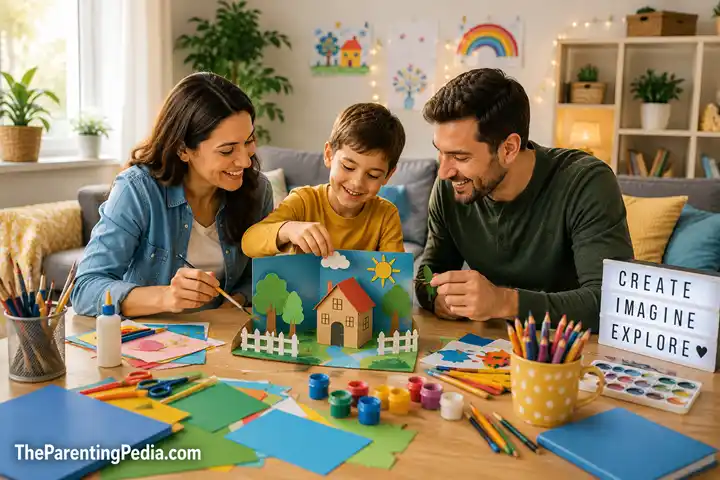
Creative activities can also make learning through play more enjoyable, especially when children have opportunities to explore ideas through play and hands-on activities.
10 Simple Everyday Habits to Encourage Creativity in Children
1. Give Your Child Time to Be Bored
“I’m bored!” is something most parents hear often.
It is tempting to immediately find something for your child to do. But you do not always have to fix boredom.
Give your child some time. They may start drawing, building, making up a game, or playing with an old toy.
The AAP notes that some boredom can leave room for creativity.
Boredom does not have to last for hours. Even a short period of free time can give children a chance to decide what interests them.
2. Encourage Unstructured Play
Not every play session needs rules or a learning goal. Give your child blocks, paper, cardboard, toys, or other safe objects and let them decide what to do.
A blanket can become a tent. Blocks can become a town. Toy animals can become a family on a journey.
Try not to take over. Let your child decide what happens next.
3. Ask Questions With More Than One Answer
Some questions have only one answer. Others open the door to many ideas.
Instead of asking, “What colour is the apple?” try, “What could we make with this box?”
You can also ask:
- “What do you think will happen next?”
- “What else could this become?”
- “Can you think of another way?”
- “What would you change?”
You do not need to turn every conversation into a lesson. Simply show your child that their ideas are worth hearing.
4. Let Your Child Make Small Choices
Creativity needs some freedom.
Let your child choose which picture to draw, which book to read, what colour to use, or which game to play.
“Would you like to draw or build?”
“Would you like the blue paper or the yellow paper?”
Small decisions help children feel that their ideas matter.
5. Encourage Pretend Play
Pretend play lets children create their own little world.
A child can become a doctor, chef, teacher, astronaut, or superhero within minutes.
A towel can become a cape. A spoon can become a microphone. A cardboard box can become a bus.
If your child asks you to join, let them lead. Ask:
“Who am I?”
“What happens next?”
Your child gets to be the director.
Pretend play gives children a chance to explore different roles, create stories, and develop their imagination without worrying about getting everything right.
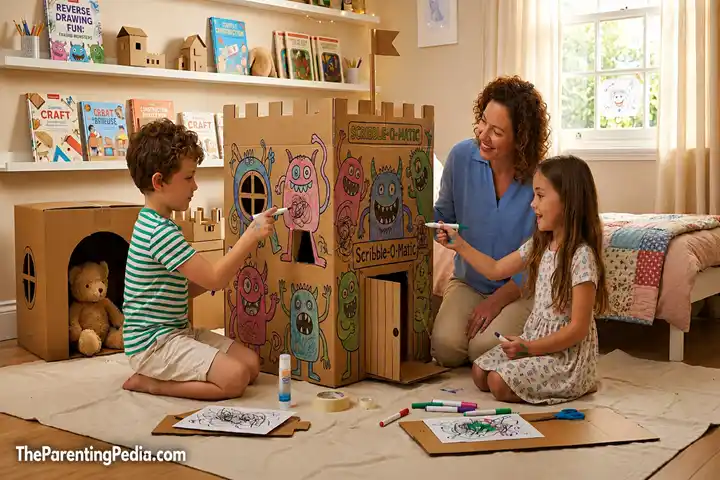
6. Keep Simple Creative Materials Nearby
You do not need an expensive craft cupboard. Keep a small box with paper, crayons, pencils, stickers, cardboard, string, old magazines, safe recycled containers, and child-safe glue.
The important thing is not how much you buy. It is how freely your child can use the materials.
Simple, open-ended materials can give children many ways to create.
7. Let Children Solve Small Problems
Parents often help because they want to make things easier. But sometimes children need time to work things out themselves.
If a tower keeps falling, ask:
“What could we change?”
If a toy does not fit into a box, ask:
“What else could we try?”
Your child may make mistakes. That is okay.
Trying, changing, and trying again are all part of creative thinking.
UNICEF also highlights pretend play as a useful way for children to build creativity, storytelling skills, and understanding of the world.
8. Make Up Stories Together
Start with one sentence:
“Once there was a little dog who found a mysterious key.”
Then stop.
Let your child decide what happens next.
You can also change the ending of a familiar story.
“What if the wolf became friends with the three little pigs?”
Storytelling gives children a simple way to create characters, places, and ideas of their own.
9. Explore Nature and the Outdoors
You do not need to plan a special trip. Take a short walk and notice leaves, flowers, insects, birds, clouds, and trees.
Ask:
“Which leaf looks unusual?”
“If this tree could talk, what would it say?”
“Can you find something shaped like a heart?”
Let your child notice, wonder, and make up ideas.
10. Do Not Fill Every Hour With Activities
Children need routines, but they also need free time.
School, homework, sports, and other activities can all be useful. But when every hour is planned, children may have little time to decide what they actually want to do.
Leave some open space during the week.
Your child may say, “I’m bored.”
That is okay.
Free time can be thinking time.
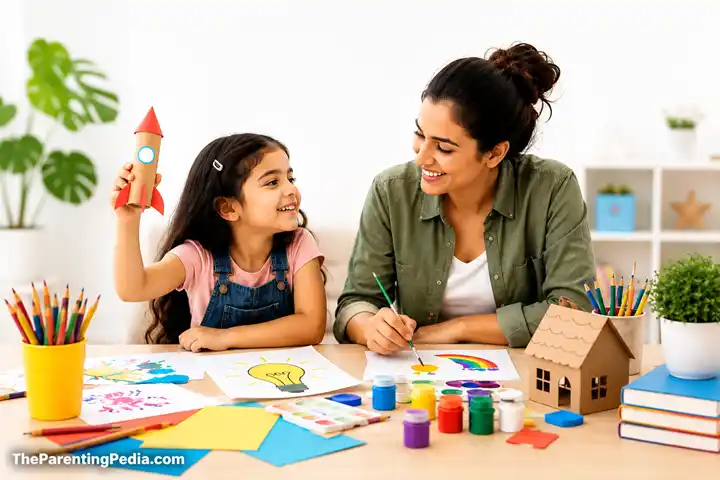
How to Encourage Creativity in Children Without Taking Over
Knowing what to do is only part of the answer. Knowing when to step back matters too.
Your child shows you a drawing. You notice the house has no windows.
Your child builds a tower and you know a better way to make it stand.
It can be tempting to correct everything.
Instead, ask:
“Tell me about your picture.”
“What made you build it that way?”
“What happens next in your story?”
These questions let your child explain the idea instead of worrying about whether it is correct.
The AAP recommends focusing on children’s effort and creative process rather than judging only the final result.
Giving children room to make their own choices can also help them become more independent and confident.
What If My Child Says, “I Don’t Know What to Do?”
This is common.
You can offer a small starting point without planning the whole activity.
Try:
“Can you make something that has never existed before?”
“Can you build a house for a tiny animal?”
“What would your bedroom look like under the sea?”
Then step back.
Your child may need some time. That is okay.
Simple Things Parents Should Avoid
Sometimes parents put pressure on children without meaning to.
Try not to:
- Correct every drawing
- Tell your child exactly how to complete a project
- Turn every creative activity into a lesson
- Compare your child’s work with another child’s work
- Fill every free moment with entertainment
Home should be a place where children can experiment safely.
Messy does not always mean bad.
Different does not always mean wrong.
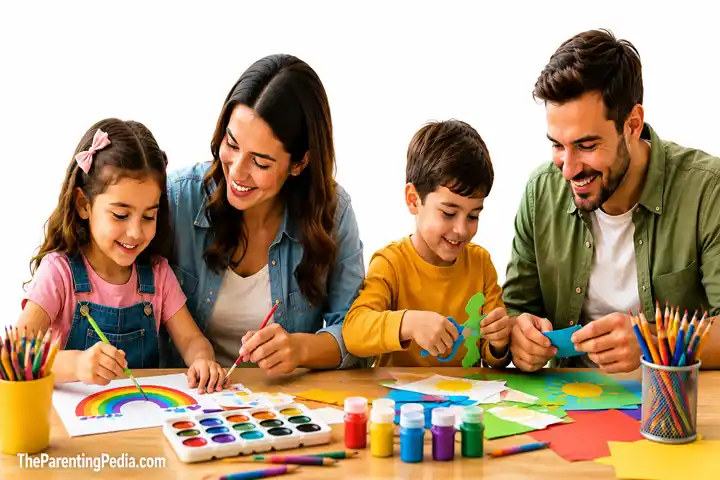
Simple materials such as paper, crayons, and household objects can give children opportunities to explore, create, and learn through play.
Frequently Asked Questions About How to Encourage Creativity in Children
How can I encourage creativity in children every day?
How to Encourage Creativity in Children can be as simple as giving them free play time, asking open-ended questions, providing simple materials, letting them make choices, and allowing them to solve small problems.
Is boredom really good for children?
Some boredom can be useful because it gives children time to decide what they want to do. The AAP notes that some boredom can leave room for creativity.
Do children need expensive toys to be creative?
No. Simple objects such as boxes, blocks, paper, and containers can provide many opportunities for creative play.
Should parents play with their children?
Yes, when possible. But parents do not need to control the game. Join your child’s play, show interest, and let your child lead.
What if my child is not interested in drawing or crafts?
That is fine. Creativity can appear through building, storytelling, music, cooking, outdoor exploration, games, or solving everyday problems.
Conclusion
Learning How to Encourage Creativity in Children does not require expensive toys, complicated activities, or a perfect parenting plan.
Let your child be bored sometimes. Give them time to play without instructions. Ask questions that make them think. Let them make choices, make mistakes, explore outdoors, and try again.
And when they hand you a cardboard box and announce that it is a rocket, do not ask where the instructions are.
Just smile and ask:
“Where are we going?”
That little question may be all the invitation their imagination needs.
Author’s Note
At TheParentingPedia, we create evidence-informed parenting content designed to help families make confident decisions. This article has been researched using guidance from trusted pediatric and child-development resources and is written in simple, practical language for parents and caregivers.

TheParentingPedia editorial team creates practical, research-informed parenting content to help parents navigate everyday challenges, child development, behavior, and family life. Our articles draw on reputable parenting and child-development sources and are reviewed for clarity, accuracy, and practical usefulness.