
Money is part of everyday family life, but children do not automatically understand how it works. Shopping, saving, paying bills, and making everyday choices can all become simple opportunities to teach children about money.
Financial literacy for kids starts with basic ideas such as earning, spending, saving, needs, wants, and making thoughtful choices. These lessons can help children develop healthy money habits as they grow.
Table of Contents
Why Is Financial Literacy Important for Kids?
Financial literacy means having the knowledge and skills to make sensible decisions about money.
Children do not need complicated financial lessons. They can start by learning to:
- Understand that money is earned
- Recognise needs and wants
- Make simple spending choices
- Save for a goal
- Compare prices
- Plan before spending
- Understand basic digital payments
The Consumer Financial Protection Bureau explains that children’s financial skills develop gradually through knowledge, habits, and everyday experiences.
The goal is not to make children worry about money. It is to help them understand that money involves choices.
What Should Kids Learn About Money?
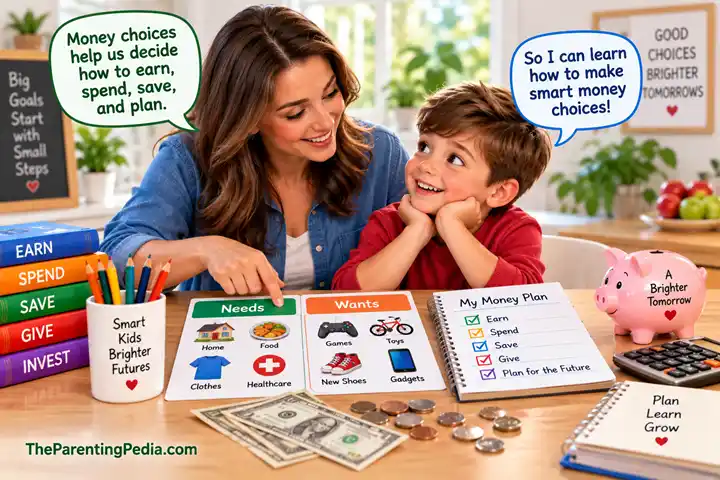
Earning Money
Explain that people generally earn money by working or providing services.
For a young child, you can say:
“People work to earn money, and we use money to pay for things we need and want.”
As children grow, you can introduce jobs, salaries, and other ways people earn money.
Saving Money
Saving teaches children that they do not have to spend everything immediately.
Help your child choose a small goal, such as a toy or book. A savings jar or progress chart can make their progress easy to see.
Spending Money
Give children opportunities to make small spending decisions.
Ask:
“Do you want to spend your money now, or save it for something else?”
This teaches them that spending money on one thing leaves less money for another choice.
Needs and Wants
A need is something necessary, such as food or basic clothing. A want is something we would like but can live without.
While shopping, ask:
“Is this something we need or something we want?”
Encourage your child to explain their answer.
Parents can also explore this practical guide to pocket money and saving for additional ideas on helping children learn to manage money.
Financial Literacy for Kids by Age
Money lessons should become more advanced as children grow.
| Age | Skills to Introduce | Simple Practice |
| 3–5 | Counting, coins, needs and wants | Pretend shopping |
| 6–8 | Saving and spending | Savings jar |
| 9–12 | Budgeting and price comparison | Simple budget |
| 13–17 | Banking, budgeting, digital money | Track spending |
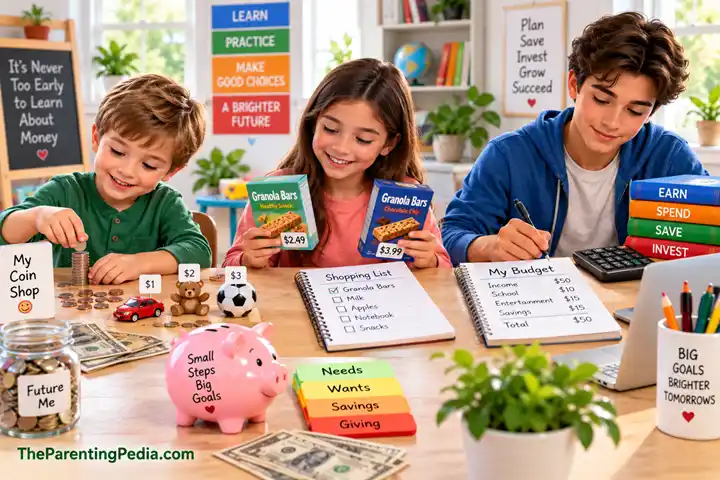
Ages 3 to 5
Use play and simple activities to teach counting, coins, pretend shopping, and needs versus wants.
Ages 6 to 8
Introduce saving, spending choices, simple goals, and price comparisons.
Ages 9 to 12
Children can begin practising simple budgets, tracking spending, comparing products, and saving for larger goals.
Ages 13 to 17
Teenagers can gradually learn about bank accounts, budgeting, digital payments, saving, online scams, credit, and borrowing.
You can make these lessons even more engaging by using simple educational games for kids at home that encourage counting, problem-solving, and decision-making.
Fun Activities to Teach Financial Literacy
Create a Pretend Store
Set up a small shop using household items. Add prices and give your child pretend money.
Let them decide what they can afford.
Create a Savings Goal
Choose a realistic goal and create a simple progress chart.
For example:
“Let’s save ₹500 for the book you want.”
Compare Prices
While shopping, compare two similar products.
Ask:
- Which costs less?
- Which offers better value?
- Do we really need it?
Track Spending
Older children can write down money they receive and spend. Review it together and ask what they learned.
[IMAGE 3 – 720 × 480 px – Children learning saving through a fun activity]
Teach Money Through Everyday Experiences
You do not need formal financial lessons every week. Everyday situations can teach valuable money skills.
While Shopping
Explain why you compare prices or decide not to buy something immediately.
“These products are similar, so let’s compare their prices.”
Digital Payments
Explain that paying by card or phone still uses real money.
As children grow, discuss online purchases, subscriptions, in-app purchases, and safe digital payment habits.
For more practical ideas about teaching children to understand spending, saving, needs, wants, and digital payments, parents can also explore this guide to teaching kids about money.
Household Expenses
When children ask about bills, explain that families have regular expenses and need to plan how money is used.
How Parents Can Model Healthy Money Habits
Children learn from what parents say and do.
Instead of silently comparing products, explain:
“I’m comparing these because I want to find the better value.”
Instead of simply saying no to an unnecessary purchase, explain why:
“We’re not buying this today because we already have something similar.”
These small conversations help children understand how adults make financial decisions.
This kind of calm guidance is also an important part of effective parenting, because children learn through everyday examples, conversations, and practical experiences.
Should Parents Give Children Pocket Money?
Pocket money can give children practical experience with spending and saving, although it is not necessary for every family.
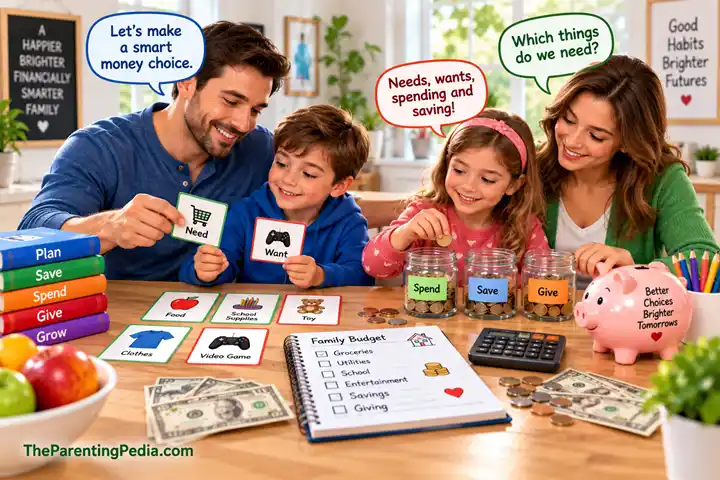
If you use pocket money, introduce three simple categories:
Spend | Save | Give
The important lesson is learning to make choices, not the amount of money given.
Common Mistakes Parents Should Avoid
Avoid:
- Shaming children for wanting something
- Using money problems to frighten them
- Giving long lectures
- Making every conversation about saving
- Never allowing small mistakes
- Making every spending decision for them
A small money mistake can become a useful lesson when parents calmly discuss what happened and what could be done differently.
The same approach of guiding children without doing everything for them can also help build independence during homework and other learning activities.
FAQs About Financial Literacy for Kids
What is financial literacy for kids?
It means helping children develop age-appropriate knowledge and habits for earning, spending, saving, and making money decisions.
What age should I start teaching children about money?
You can start with simple concepts during the preschool years through counting, pretend shopping, and needs-and-wants activities.
How can I teach my child to save?
Give them a small, specific goal and use a savings jar or progress chart to show their progress.
Should children receive pocket money?
Pocket money is optional. If you use it, it can provide practical experience with spending and saving.
How do I teach needs versus wants?
Use everyday shopping situations and ask your child whether an item is necessary or simply something they would like.
How can I teach children about digital payments?
Explain that cards and phones still use real money. As children grow, introduce online safety, subscriptions, and in-app purchases.
Author’s Note
At TheParentingPedia, our goal is to provide practical, easy-to-understand parenting information for families.
This article is for general educational purposes and should be adapted to a child’s age, maturity, and family circumstances.
Sources and Further Reading
- Federal Deposit Insurance Corporation (FDIC) — Money Smart for Young People
FDIC — Money Smart for Young People
Useful for age-appropriate financial education, saving, budgeting, needs vs. wants, and money conversations with children. - Consumer.gov — Making a Budget
Consumer.gov — Making a Budget
Provides a simple explanation of budgeting, spending, income, and saving. - FDIC — How Money Smart Are You?
FDIC — How Money Smart Are You?
Offers interactive financial education games covering earning, spending, saving, banking, and financial planning.
Conclusion
Teaching children about money does not require complicated lessons. Financial literacy for kids develops through everyday conversations, practical activities, and age-appropriate choices.
Start with earning, saving, spending, needs, and wants. As children grow, gradually introduce budgeting, digital payments, and online safety.
Give children opportunities to practise. A shopping trip, savings goal, or simple spending decision can become a valuable lesson.
With patient guidance, children can gradually develop the knowledge and habits they need to make thoughtful financial choices.

TheParentingPedia editorial team creates practical, research-informed parenting content to help parents navigate everyday challenges, child development, behavior, and family life. Our articles draw on reputable parenting and child-development sources and are reviewed for clarity, accuracy, and practical usefulness.