
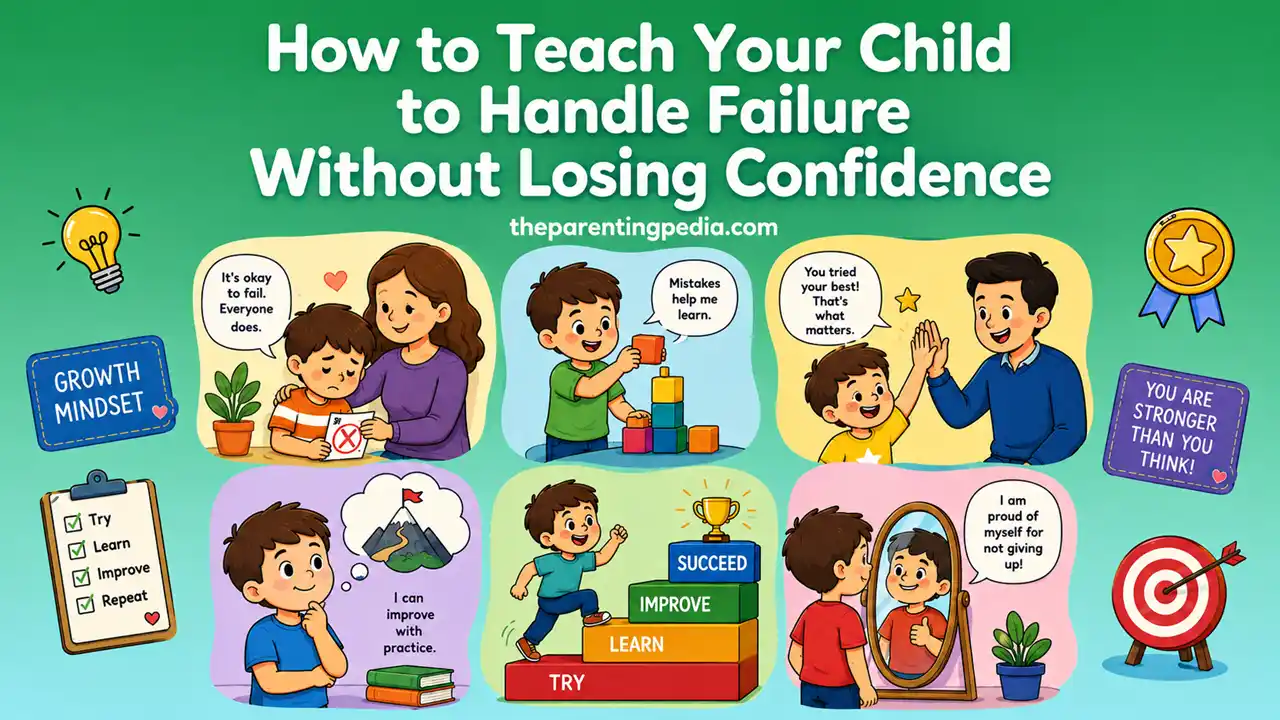
Every parent dreams of seeing their child succeed. Whether it’s earning good grades, winning a sports competition, or making new friends, success brings joy and pride. However, failure is an unavoidable part of life. Every child will eventually face disappointment, rejection, mistakes, or setbacks.
The real challenge is not preventing failure but teaching children how to respond to it. When you teach your child to handle failure, you prepare them for real-life challenges and help them develop confidence, resilience, and emotional strength.
Children who understand that failure is a stepping stone to success become more willing to take healthy risks, learn from mistakes, and continue trying even when things become difficult. These qualities are essential for lifelong success.

Table of Contents
Why It Is Important to Teach Your Child to Handle Failure
Many parents naturally want to protect their children from disappointment. While this comes from love, shielding children from every setback can prevent them from learning valuable life lessons.
Failure helps children:
- Develop emotional resilience
- Improve problem-solving skills
- Learn patience and perseverance
- Build self-confidence through experience
- Understand that success requires effort
Children who learn to accept failure are more likely to become confident adults who are not afraid to face new challenges.
AboutKidsHealth recommends giving children age-appropriate opportunities to solve problems and learn from everyday mistakes.
Why Some Children Fear Failure
Not every child reacts to failure in the same way. Some recover quickly, while others lose confidence and stop trying. Understanding the reasons behind this fear helps parents provide the right support.
Fear of Disappointing Parents
Children often worry more about disappointing their parents than about the failure itself. They may believe they are loved only when they succeed.
High Expectations
When children feel they must always be perfect, even small mistakes can seem like major failures.
Comparing Themselves With Others
Constant comparisons with siblings, classmates, or friends can make children believe they are not good enough.
Previous Negative Experiences
Harsh criticism, punishment, or embarrassment after making mistakes can make children afraid of trying again.
Every setback is an opportunity to learn. Parents can also explore practical ways to build self-confidence in children so they feel motivated to try again after facing failure.
Signs Your Child Is Struggling to Handle Failure
Parents should watch for early warning signs that indicate their child is finding it difficult to cope with setbacks.
Some common signs include:
- Giving up easily when tasks become difficult
- Avoiding competitions or challenging activities
- Becoming extremely upset after making small mistakes
- Refusing to try again after one failure
- Saying things like:
- “I’m not good enough.”
- “I always fail.”
- “I’ll never be successful.”
Recognizing these behaviors early allows parents to guide children toward healthier thinking patterns.
7 Practical Ways to Teach Your Child to Handle Failure
1. Allow Your Child to Experience Small Failures
Parents often step in to solve every problem. While this may seem helpful, children need opportunities to experience manageable setbacks.
For example:
- Losing a board game
- Forgetting homework once
- Missing a goal during a football match
- Not winning a school competition
These experiences teach children that failure is temporary and can be overcome through learning and persistence.
Instead of fixing every problem immediately, encourage your child to think about what they could do differently next time.
2. Praise Effort Instead of Results
Children who receive praise only when they win may begin to believe that success determines their worth.
Instead of saying,
“I’m proud because you came first.”
Try saying,
“I’m proud of how hard you worked and how you never gave up.”
This simple change encourages children to value effort, persistence, and learning rather than perfection.
3. Share Your Own Failures
Children often believe adults never make mistakes.
Share age-appropriate stories about times when you:
- Failed an exam
- Lost an important opportunity
- Made a mistake at work
- Didn’t achieve a goal on your first attempt
Then explain what you learned and how you improved.
When children see that even parents experience setbacks, they understand that failure is a normal part of life rather than something to fear.
Many children also struggle because they haven’t yet learned healthy ways to manage difficult emotions.
Quick Guide for Parents – What to Say and What to Avoid
| Situation | Instead of Saying | Say This Instead |
| Your child fails an exam | “You didn’t study enough.” | “Let’s see what we can learn from this.” |
| Your child loses a competition | “Maybe you’re not good at this.” | “I’m proud that you gave your best.” |
| Your child makes a mistake | “Why did you do that?” | “Mistakes help us learn and improve.” |
| Your child wants to quit | “Fine, give up.” | “Let’s try one more time together.” |
| Your child feels disappointed | “Stop crying.” | “It’s okay to feel upset. Let’s talk about it.” |
The image below shows how calm parental support can help a child recover from disappointment.

Continue Teaching Your Child to Handle Failure With These Practical Strategies
4. Encourage Problem-Solving Instead of Blaming
When your child experiences failure, avoid immediately giving advice or solving the problem for them.
Instead, ask questions like:
- What do you think happened?
- What did you learn from this experience?
- What could you do differently next time?
- How can I help you improve?
These questions teach children to focus on solutions instead of dwelling on mistakes.
5. Teach That Mistakes Are Opportunities to Learn
Many successful people failed multiple times before achieving success. Explain to your child that every mistake teaches an important lesson.
Help them understand that:
- Failure is temporary.
- Every expert was once a beginner.
- Improvement comes through practice.
- Success rarely happens on the first attempt.
Children who understand this mindset become more willing to try again after setbacks.
6. Avoid Comparing Your Child With Others
One of the quickest ways to damage a child’s confidence is through constant comparison.
Avoid saying things like:
- “Look how well your cousin performed.”
- “Your friend scored better than you.”
- “Why can’t you be like your sister?”
Instead, compare your child’s present performance with their own previous progress.
Celebrate personal improvement rather than comparing achievements with others.
7. Celebrate Progress, Not Just Success
Success deserves recognition, but so does effort.
Celebrate moments such as:
- Trying something new
- Practising regularly
- Improving after mistakes
- Showing courage despite fear
- Refusing to give up
This teaches children that growth is more important than perfection.

Common Parenting Mistakes That Increase Fear of Failure
Even well-meaning parents sometimes unintentionally increase a child’s fear of failure.
Avoid these common mistakes:
Expecting Perfection
Perfection is impossible. Unrealistic expectations create unnecessary pressure.
Criticising Every Mistake
Constant criticism makes children afraid to take healthy risks.
Solving Every Problem
Children need opportunities to overcome challenges independently.
Rewarding Only Success
Recognise hard work, determination, honesty, and perseverance—not just winning.
Simple Daily Activities That Build Resilience
Building resilience doesn’t require expensive classes. Small daily habits make a big difference.
Try these activities:
- Play board games where everyone sometimes loses.
- Encourage your child to learn a new skill.
- Read inspiring stories about successful people who failed before succeeding.
- Discuss daily challenges at dinner and ask what everyone learned.
- Praise effort and persistence every day.
These habits gradually help children develop confidence and emotional strength.
How Parents Can Build Resilience at Every Age
| Child’s Age | How Parents Can Help |
| 3–5 Years | Encourage trying again after simple mistakes and praise effort. |
| 6–9 Years | Teach problem-solving, celebrate improvement, and avoid comparisons. |
| 10–13 Years | Help children reflect on failures, set realistic goals, and develop resilience. |
| 14–18 Years | Encourage independence, discuss setbacks openly, and focus on long-term learning instead of perfection. |
Long-Term Benefits When You Teach Your Child to Handle Failure
Children who learn to handle failure develop skills that benefit them throughout life.
These children are more likely to:
- Become confident decision-makers.
- Handle stress more effectively.
- Recover quickly after setbacks.
- Develop leadership qualities.
- Build healthy relationships.
- Continue learning throughout life.
- Achieve long-term success through persistence.
The confidence gained from overcoming challenges often becomes one of the greatest gifts parents can provide.
The American Psychological Association explains that resilience helps children adapt to setbacks and build lifelong emotional strength.
Frequently Asked Questions (FAQs)
At what age should parents start teaching children about failure?
Parents can begin as early as the preschool years by encouraging children to try again after small mistakes and praising their effort rather than only their achievements.
Should I comfort my child after failure?
Yes. Offer emotional support first, then help your child reflect on what they learned and how they can improve next time.
Is failure good for children?
Healthy, age-appropriate failures help children build resilience, confidence, and problem-solving skills. They learn that setbacks are temporary and can lead to growth.
What should I avoid saying after my child fails?
Avoid statements such as:
“I told you so.”
“You’re just not good at this.”
“Why can’t you be like someone else?”
Instead, encourage your child by focusing on learning
Can children become more confident after failure?
Absolutely. With encouragement, patience, and guidance, children often become more confident because they realise they can recover, improve, and succeed after setbacks.
Conclusion
Every child will experience failure at some point, but failure does not define who they are or what they can achieve. What truly matters is how they respond to those setbacks.
When you teach your child to handle failure, you are helping them build resilience, confidence, perseverance, and emotional strength that will serve them throughout life. Encourage effort, celebrate progress, allow mistakes, and remind your child that every setback is an opportunity to learn and grow.
Children who believe they can learn from failure are more likely to become confident adults who embrace challenges instead of fearing them.

TheParentingPedia editorial team creates practical, research-informed parenting content to help parents navigate everyday challenges, child development, behavior, and family life. Our articles draw on reputable parenting and child-development sources and are reviewed for clarity, accuracy, and practical usefulness.