Children spend hours studying, reading, writing, attending school, and using screens. After sitting for a long time, many children need more than another reminder to “concentrate.” A short movement break can help them step away from the desk, move their bodies, and return to their activity refreshed.
Brain Gym exercises for kids are often presented as simple movements involving coordination, concentration, and body awareness. The video that inspired this article demonstrates hand coordination, nose-and-ear movements, using the non-dominant hand, movement patterns, and breathing exercises.
Parents should keep expectations realistic. Research suggests that physical activity and cognitively engaging movement can support aspects of children’s cognitive functioning, but it does not prove that a particular Brain Gym exercise will automatically increase intelligence or guarantee better memory.
Table of Contents
What Are Brain Gym Exercises for Kids?
Brain Gym is a popular term for activities that combine simple physical movements with attention and coordination. These activities can include moving both hands in different patterns, coordinating opposite sides of the body, following movement sequences, trying simple tasks with the non-dominant hand, and combining movement with mental attention.
For parents, the best approach is to treat these activities as fun movement and coordination games, rather than as a guaranteed way to make children smarter.
For more playful ways to build memory, concentration, and problem-solving skills, parents can also explore our guide to educational games at home.
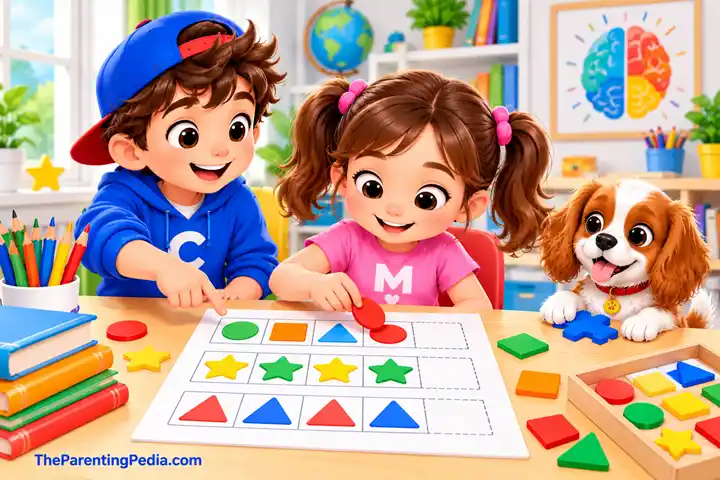
Why Movement Can Be Useful During Study Time
Physical activity is important for children’s health and development. Research has also found positive associations between physical activity and aspects of cognition in children, although results vary depending on the type and design of the activity.
Japan’s Ministry of Education, Culture, Sports, Science and Technology highlights the importance of physical activity and sports opportunities for children from an early age.
So instead of telling your child that an exercise will “boost brain power,” encourage them to move, play, coordinate, and take a healthy break from sitting.
1. Opposite-Hand Coordination Exercise
Ask your child to hold one hand with the palm facing upward and the other with the palm facing downward. Then ask them to change the positions together.
Start slowly. Once your child understands the movement, repeat it several times. You can gradually increase the speed if your child is comfortable.
Make it a family game. Take turns being the leader, and let your child give you the instructions. The goal is not perfection. It is simply a playful challenge involving attention and coordination.
2. Try the Nose-and-Ear Game
Ask your child to:
- Touch their nose with one hand.
- Touch the opposite ear with the other hand.
- Bring both hands back.
- Switch sides.
- Repeat the sequence.
Start slowly and increase the speed only when your child understands the pattern.
Children will probably make mistakes. That’s part of the fun. Instead of saying, “You did it wrong,” try: “Let’s try it again and see if we can do it faster!”
3. Use the Non-Dominant Hand
If your child normally uses the right hand, they could try drawing a simple shape with the left hand. Other safe activities include colouring, tracing, drawing, moving soft toys, or building with blocks.
The unfamiliar movement may make an ordinary activity feel like a new challenge.
Never use this activity with sharp objects, hot items, or anything that could cause injury.
4. Create a Movement-and-Memory Pattern
Start with two movements:
Clap → Touch shoulders
Ask your child to repeat them. Then add another:
Clap → Touch shoulders → Touch knees
Once your child remembers the sequence, add another movement. You can gradually make the pattern longer.
Let your child invent a movement sequence for you. They have to think about the order, remember it, demonstrate it, and watch whether you follow it correctly. That turns a simple movement game into an opportunity for attention, memory, and coordination.
5. Finish With a Gentle Breathing Break
The video also demonstrates alternate-nostril breathing.
For children, keep breathing activities gentle and comfortable. Avoid promising that a particular breathing technique will automatically improve memory or “activate both sides of the brain.”
A simpler option is:
Breathe in slowly → breathe out slowly → repeat comfortably.
There is no need to force the breath or hold it for a long time. Stop if your child feels dizzy, uncomfortable, or short of breath.
Parents can also include creative thinking activities, and our guide to cultivating creativity in kids offers simple ideas to try at home.
When Should Children Try These Activities?
These exercises can be used as short movement breaks rather than replacements for regular exercise or outdoor play.
Try them:
- Before homework
- Between study sessions
- After extended screen time
- When your child feels restless
- During a long homework session
- Before reading and writing
A movement break does not need to become another scheduled academic task.
A Simple 5-Minute Brain Break
Minute 1: Hand coordination
Minute 2: Nose-and-ear game
Minute 3: Drawing with the other hand
Minute 4: Movement-and-memory pattern
Minute 5: Gentle breathing
You don’t have to complete all five activities every time. The aim is simply to interrupt prolonged sitting with something active and enjoyable.
Don’t Turn Brain Exercises Into More Homework
If your child enjoys these activities, encourage them. If they don’t, don’t force them.
Children can make mistakes, laugh, change the rules, and invent their own movements. You could ask:
“Can you create a new movement challenge for me?”
This turns the activity into a shared parent-child game instead of another task that the child has to complete correctly.
Parents who want to support focus during study time can also use these calm homework strategies to make homework less stressful.
Can Brain Gym Improve Concentration and Memory?
Research supports a broader relationship between physical activity and children’s cognitive functioning. However, it does not justify promising that a specific Brain Gym exercise will definitely improve a child’s memory or concentration.
If your child consistently struggles with concentration, reading, writing, memory, or schoolwork, don’t rely only on movement exercises. Sleep, stress, learning difficulties, vision, hearing, and other factors may also affect learning.
FAQs
Are Brain Gym exercises suitable for children?
Simple movement and coordination games can be suitable for many children when they are safe, age-appropriate, and enjoyable. They should be viewed as activities rather than guaranteed brain-boosting treatments.
How long should children do these exercises?
A few minutes can work well as a movement break. There is no need to make the activity long or stressful.
Can Brain Gym exercises improve memory?
There is not enough evidence to guarantee that specific Brain Gym exercises improve memory. Research supports broader benefits associated with physical activity and cognition, but results vary.
Conclusion
Brain Gym-style activities can give children a fun way to move, coordinate, and take a break from prolonged sitting.
Simple hand games, movement patterns, non-dominant-hand activities, and gentle breathing require little or no equipment and can easily be tried at home.
Parents should keep expectations realistic. These activities are not a guaranteed shortcut to better memory or higher intelligence. The stronger evidence concerns the broader relationship between physical activity and children’s cognitive health.
The best approach is simple: make movement fun, keep it safe, and make active breaks a natural part of your child’s day.
Author’s Note
At TheParentingPedia.com, we aim to provide practical parenting information while distinguishing popular claims from what current research supports. These activities are general ideas for movement and coordination and are not a substitute for professional medical, developmental, or educational advice.
Sources & Further Reading
- Donnelly JE, et al. Physical Activity, Fitness, Cognitive Function, and Academic Achievement in Children: A Systematic Review.
https://pmc.ncbi.nlm.nih.gov/articles/PMC4874515/ - Sember V, et al. Children’s Physical Activity, Academic Performance, and Cognitive Functioning: A Systematic Review and Meta-Analysis.
https://www.frontiersin.org/journals/public-health/articles/10.3389/fpubh.2020.00307/full

TheParentingPedia editorial team creates practical, research-informed parenting content to help parents navigate everyday challenges, child development, behavior, and family life. Our articles draw on reputable parenting and child-development sources and are reviewed for clarity, accuracy, and practical usefulness.