Children are naturally curious about the world around them. A butterfly landing on a flower, a bird singing from a tree, a tiny ant carrying food, or a seed beginning to grow can capture a child’s attention in ways that no worksheet can.
Yet modern family life often keeps children indoors for much of the day. School, homework, screens, busy schedules, and limited outdoor spaces can make it easy for children to lose opportunities to explore the natural world.
Connecting children with nature does not require regular camping trips, a large garden, or expensive outdoor equipment. It can begin with a few minutes spent watching birds from a window, caring for a houseplant, walking through a local park, or simply noticing how the seasons change.
The goal is not to turn every outdoor experience into a science lesson. It is to help children develop curiosity, respect, confidence, and a sense of belonging in the natural world.
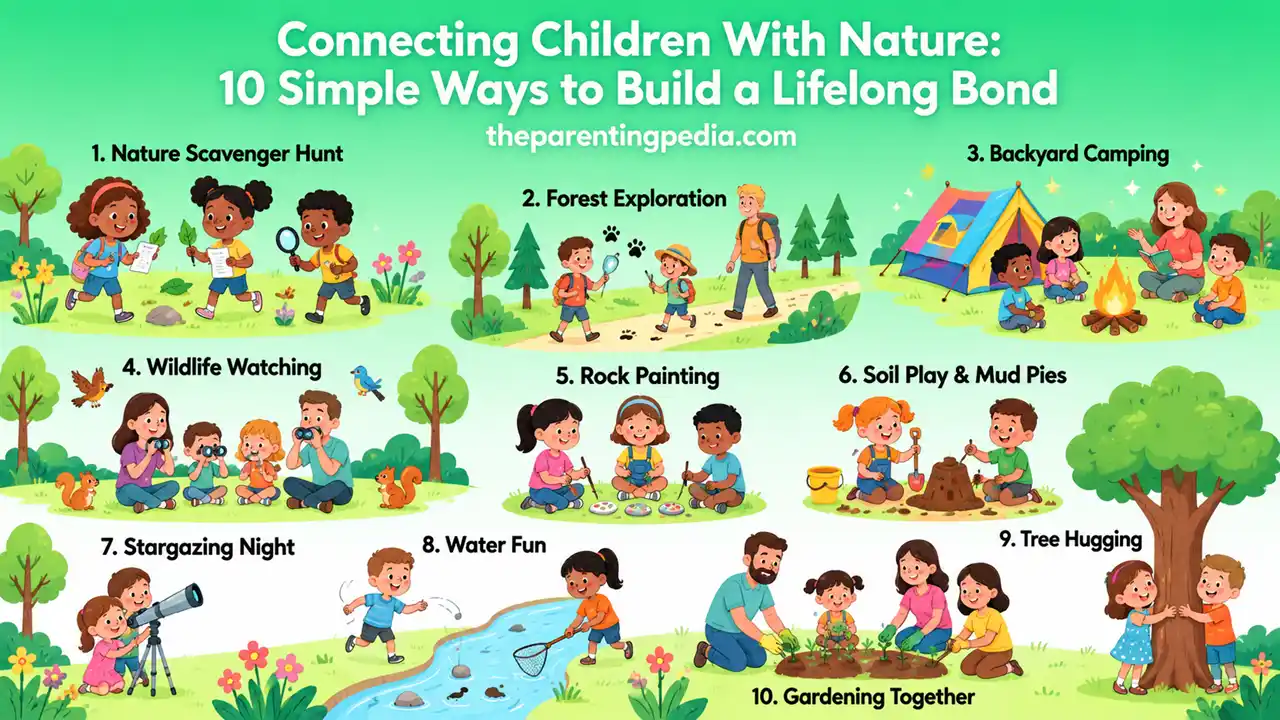
Here are 10 simple ways families can make nature a meaningful part of everyday childhood.
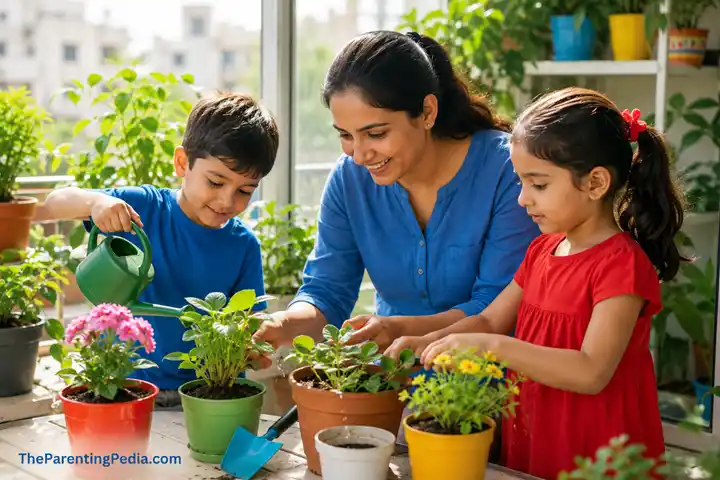
Table of Contents
1. Take Regular Nature Walks
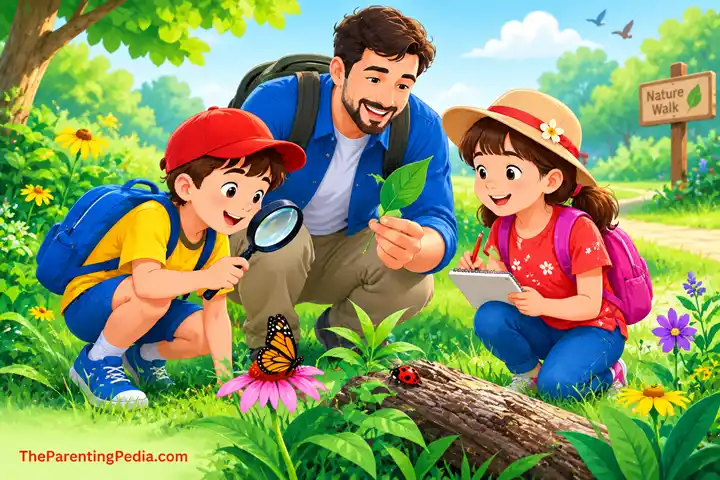
A nature walk does not need to be a long hike through the countryside.
A short walk around your neighbourhood, local park, garden, or nearby green space can become an opportunity to explore.
Instead of telling your child what to look at, encourage them to notice things themselves.
Ask:
- What colours can you see?
- Can you hear any birds?
- How many different types of leaves can you find?
- Can you spot an insect?
- What has changed since our last walk?
Let your child set the pace. Sometimes the most interesting discovery is something adults would normally walk straight past.
Regular walks are one of the easiest ways of connecting children with nature because they turn outdoor exploration into a normal family habit.
2. Let Your Child Grow a Plant
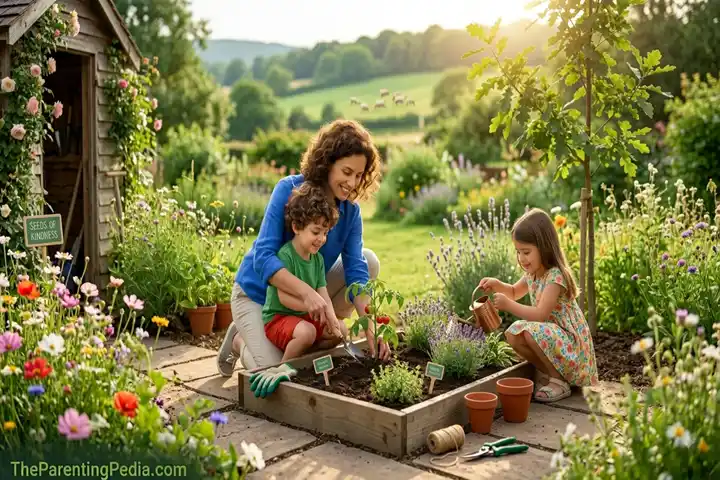
Children often become fascinated when they see something they planted begin to grow.
You can start with a small pot on a windowsill, balcony, patio, or garden.
Let your child help with:
- Adding soil
- Planting seeds
- Watering appropriately
- Observing new leaves
- Measuring growth
- Drawing the plant
You can even create a simple plant diary.
Write down when the seed was planted and encourage your child to draw what it looks like each week.
This teaches patience and responsibility while helping children understand that living things need care.
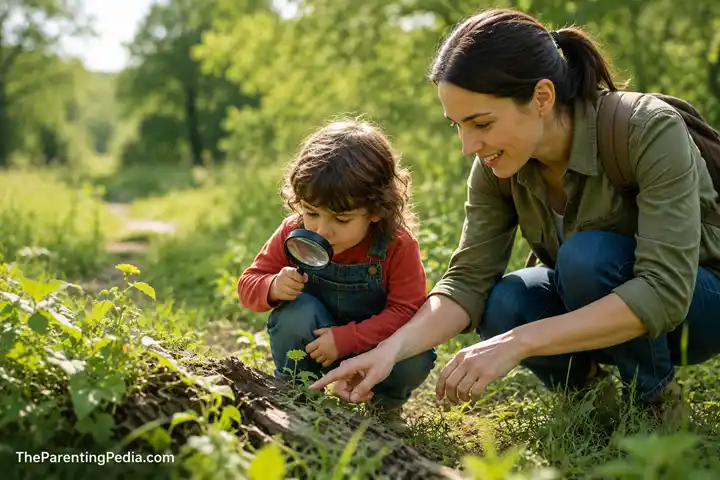
3. Go on a Biodiversity Hunt
Children do not need to understand complicated scientific terminology to begin learning about biodiversity.
Simply explain that nature is home to many different living things, including plants, insects, birds, animals, fungi, and other organisms.
During your next outdoor trip, challenge your child to find as many different forms of life as possible.
Perhaps they discover:
- Three different types of leaves
- A bee visiting a flower
- Several kinds of birds
- Different grasses
- A spider web
- Moss growing on a wall
Rather than encouraging children to collect living things, teach them to observe without disturbing them.
This helps children appreciate that even tiny creatures and plants have a place in the natural world.
4. Encourage Nature-Based Outdoor Play
Outdoor play does not always need to involve organised sports or expensive toys.
Give children time and space to invent their own games.
A fallen branch might become part of an imaginary adventure. Stones can become stepping points. Leaves can inspire artwork. A patch of grass can become the setting for an imaginary story.
Unstructured outdoor play gives children opportunities to move, experiment, imagine, and solve small problems independently.
Parents can also introduce simple activities such as:
- Nature scavenger hunts
- Leaf matching
- Cloud watching
- Colour hunts
- Bird spotting
- Nature drawing
- Listening games
The less complicated the activity, the more opportunity children often have to use their own imagination.
Spending time outdoors can support children’s physical health, social skills, concentration, and emotional well-being, according to UNICEF.
5. Create a Nature Journal
A nature journal gives children a reason to slow down and observe.
Give your child a notebook and encourage them to record things they notice outdoors.
They might draw:
- A flower
- A bird
- A tree
- An insect
- A cloud
- A favourite outdoor place
Older children can write a few sentences about what they observed.
For example:
“Today I saw a robin sitting on a fence.”
“I noticed that the tree has fewer leaves than last month.”
“I found three different kinds of flowers.”
The journal does not need to be perfect. Spelling and artistic ability are less important than encouraging observation and curiosity.
6. Watch Birds and Other Wildlife
You do not need specialist equipment to introduce children to wildlife watching.
Start by looking through a window or sitting quietly in a garden or park.
Ask your child to watch without chasing or disturbing the animals.
You could keep a simple family wildlife list:
Birds we spotted this week
Insects we noticed
Animals seen in our local park
Over time, your child may begin recognising different birds, insects, or animal behaviours.
This can turn an ordinary outdoor moment into a small discovery.
Nature-based activities can also make learning more enjoyable, just like other educational games for kids at home
7. Make Nature Part of Family Time
Nature does not have to be something children experience separately from family life.
Make it part of your normal routine.
You might:
- Eat a snack outside
- Have a weekend picnic
- Walk instead of taking the car for a short journey
- Visit a local park after school
- Garden together
- Watch the sunset
- Look at the stars on a clear evening
- Take a short family walk after dinner
These simple experiences can become family traditions.
Connecting children with nature becomes much easier when children see that parents also enjoy noticing and exploring the natural world.
8. Teach Children to Care for Nature
Enjoying nature is only part of the relationship. Children can also learn how to protect it.
Start with simple lessons.
Teach children to:
- Put rubbish in the correct bin
- Avoid damaging plants
- Leave wild animals alone
- Avoid disturbing nests
- Use water thoughtfully
- Respect shared outdoor spaces
You can explain that nature is a home for many different living things.
A child who learns to observe a butterfly without catching it, or admire a flower without pulling it, is learning an important lesson about respect.
These small habits can gradually become part of the child’s everyday behaviour.
9. Bring Nature Indoors
Not every family has easy access to large parks, gardens, forests, or countryside.
That does not mean children have to miss out.
Bring small pieces of nature into everyday indoor life.
Try:
- Growing herbs on a windowsill
- Keeping child-friendly houseplants
- Reading books about animals and plants
- Looking through nature photographs
- Listening to recordings of birdsong
- Watching a seed grow
- Drawing plants and animals
You can also encourage your child to look outside the window and observe what is happening.
What birds visit? Has the weather changed? Are there new flowers? Are the trees losing leaves?
Even these small observations can help children feel more connected to the living world around them.
10. Let Children Lead the Exploration
Perhaps the most important way of connecting children with nature is to let children have some control over what they explore.
Adults often have a plan.
Children often have curiosity.
If your child suddenly becomes interested in an unusual leaf, tiny insect, puddle, bird, or strange-looking tree, stop and explore it together.
Ask questions instead of immediately giving answers.
“What do you think it is?”
“Why do you think it looks like that?”
“Where do you think it came from?”
“What could we find out about it?”
You do not need to know every answer. Saying, “I don’t know. Let’s find out together,” shows children that curiosity is something to be encouraged.
How to Make Nature a Regular Part of Childhood
The biggest benefit does not come from doing one special nature activity once.
It comes from repetition.
Try creating a simple family routine:
Every day: Spend a few minutes noticing something outdoors.
Every week: Take a nature walk or visit a green space.
Every month: Try a new nature-related activity.
Throughout the year: Notice seasonal changes.
This approach removes pressure from parents. You do not need to organise an elaborate outdoor adventure every weekend.
Small experiences can add up.
What If Your Child Prefers Screens?
Do not make nature feel like a punishment for enjoying technology.
Instead, create interesting reasons to go outside.
Try a nature scavenger hunt, outdoor photography, bird spotting, drawing, gardening, or a family challenge.
You can even use technology occasionally as a tool for learning about something you have discovered together.
The goal is not to eliminate screens completely. It is to give children meaningful experiences beyond screens.
Simple outdoor experiences can be combined with other screen-free activities for children to create more opportunities for active family time.
Safety Tips for Nature Activities
Nature exploration should always be age-appropriate and supervised when necessary.
Teach children not to eat unknown berries, plants, mushrooms, or other natural objects.
Encourage them not to touch unfamiliar animals or insects. Stay particularly alert around roads, deep water, cliffs, extreme weather, and other genuine hazards.
Children should learn to respect nature without being frightened of it.
The aim is to help them become confident and responsible explorers.
Frequently Asked Questions
Why is connecting children with nature important?
Connecting children with nature gives them opportunities to explore, observe, move, ask questions, use their imagination, and develop respect for living things. Regular outdoor experiences can also provide valuable opportunities for learning and family connection.
How can I connect my child with nature if we live in a city?
You can use local parks, community gardens, balconies, windowsills, neighbourhood walks, and even views from your home. Nature does not have to mean a forest or countryside.
What is the easiest nature activity for children?
Start with a simple nature walk. Ask your child to find five things they have not noticed before. It requires almost no preparation.
How can I teach children about biodiversity?
Encourage them to notice the variety of plants, insects, birds, animals, and other living things around them. Explain that different living things depend on one another and their habitats.
What if my child is not interested in nature?
Follow their interests. If they like drawing, try nature sketching. If they enjoy collecting information, create a wildlife notebook. If they love games, organise a nature scavenger hunt. Finding the right entry point can make outdoor exploration much more enjoyable.
A child’s surroundings, including access to safe green spaces, can influence development and the experiences that shape a growing brain, explains the Harvard Center on the Developing Child.
Conclusion
Connecting children with nature does not require expensive equipment, complicated lessons, or faraway adventures.
It can begin with a seed planted in a small pot, a bird spotted from a window, a walk through a local park, or a child stopping to examine an unusual leaf.
The most important thing is to give children regular opportunities to notice, explore, question, and care.
When families make room for nature in everyday life, children can gradually develop something more meaningful than knowledge about plants and animals. They can develop curiosity, respect, responsibility, and a lasting sense of connection with the world around them.
Sometimes, the simplest invitation is the most powerful:
“Let’s go outside and see what we can discover.”
Author’s Note
At TheParentingPedia, we create evidence-informed parenting content designed to help parents, caregivers, teachers, and families make confident decisions. Our articles are researched using trusted child-development and family resources and written in simple, practical language.

TheParentingPedia editorial team creates practical, research-informed parenting content to help parents navigate everyday challenges, child development, behavior, and family life. Our articles draw on reputable parenting and child-development sources and are reviewed for clarity, accuracy, and practical usefulness.