
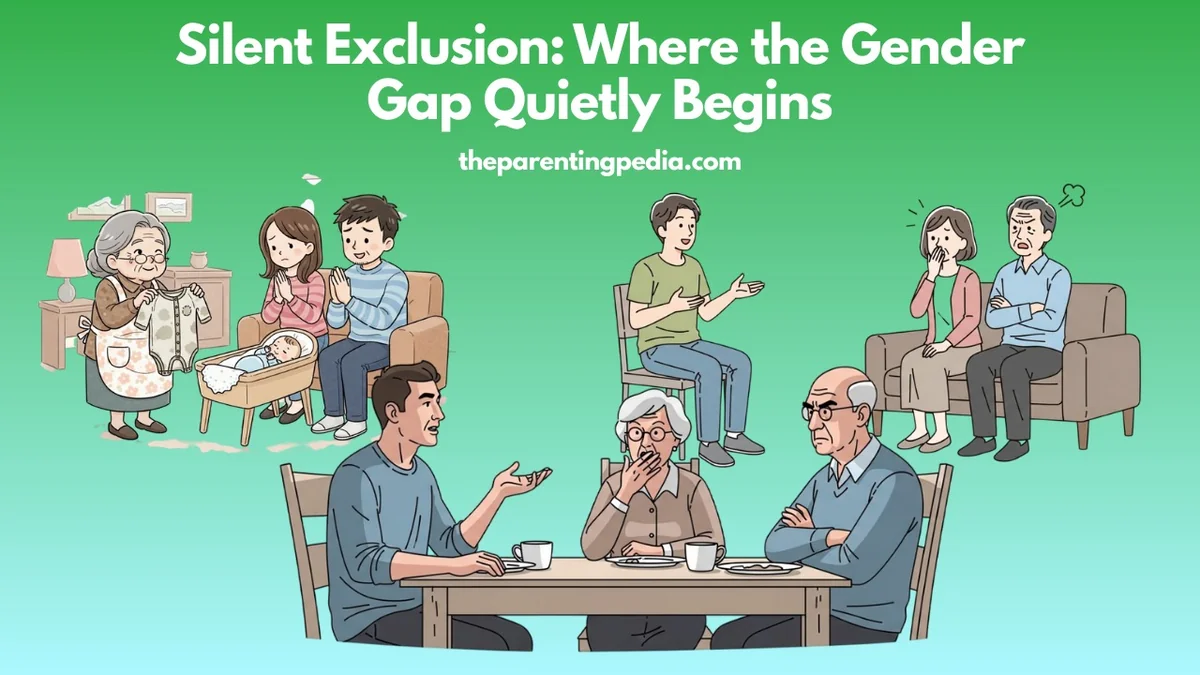
Yesterday at the dinner table, my eight-year-old said something that stayed with me long after the plates were cleared.
“You know, Mamma, at Harsh’s birthday party two days back, I was the only girl who turned up. The rest were all boys. After some time, they all decided to play cricket and I was all alone. I felt lost, so I went to help Harsh’s elder sister with the birthday preparations.”
She said it casually. But her face told another story.
There was no dramatic incident. No teasing. No harsh words. No one told her she could not play. Yet something had happened. Something subtle. Something powerful.
What she experienced was silent exclusion.
When No One Says “No,” But No One Says “Yes” Either
Children at that age are deeply sensitive to belonging. Peer acceptance often matters more than adult reassurance. When the group shifted to cricket which is a loud, rule-heavy, traditionally male-dominated game, she found herself outnumbered.
No one told her to step aside. But no one invited her in. And that is how silent exclusion works. It doesn’t shout. It doesn’t accuse. It doesn’t leave visible scars. But it quietly communicates: You are not central here. You don’t quite belong.
This was not about confidence. My daughter is confident. This was not about capability. She can play. This was about a social dynamic that many children girls and boys alike encounter in subtle ways. When invitation is absent, silent exclusion fills the space. And for a child, the internal message can easily become: There is no place for me here.

Why Small Moments Matter
We often dismiss such incidents as minor. “It was just a party.” “Children will sort it out.” “She could have joined if she wanted.” But developmentally, these are formative moments. Repeated experiences of silent exclusion can slowly shape a child’s internal narrative. A child may begin to withdraw instead of asserting presence. She may wait to be invited rather than step forward. Or she may over-adapt like people-pleasing, minimizing her preferences to fit in. This one party will not define her. But patterns matter.
Also Read: https://www.unicef.org/education/gender-equality
Over time, silent exclusion can teach a child that belonging is conditional. That access must be granted. That some spaces are not automatically hers. And this is where the conversation becomes bigger than cricket.
This Is Not About Blame
It is important to separate emotion from accusation. The boys were not villains. They likely did not even notice. This is precisely how silent exclusion operates, it is often unconscious. Children follow momentum. They choose what feels familiar. Systems default to comfort.
Also Watch: https://www.youtube.com/watch?v=2Oexo0jpstk
My concern was not that she was denied participation. My concern was that she neither joined voluntarily nor voiced her need. She said she felt lost but she stayed lost. That was the moment I realized this was an opportunity. Not for blame, not for lecturing but for skill-building.
Teaching Agency Without Toughening
The goal is not to “toughen up” our children. Nor is it to tell them to ignore their feelings. The goal is to build agency. Instead of asking, “Why didn’t you join?” we can ask:
- “What would have made that party feel better for you?”
- “What do you think you could try next time?”
- “What help would you want?”
These questions restore voice. We can teach children simple phrases like:
- “Can I play too?”
- “What are the rules? I want to try.”
- “Can I be on the next team?”
- “I don’t know cricket much. Can someone show me?”
These are not aggressive demands. They are invitations to participate. They interrupt silent exclusion gently. Children can also learn to say:
- “I feel left out.”
- “I am not sure what to do right now.”
- “Can you help me join?”
Asking for help is not weakness. It is strength. It is agency in action. When we equip children with options, we reduce the power of silent exclusion over their self-worth.
The Parent’s Role: Validate First
When she spoke, I felt many things like sadness, anger, helplessness. Those emotions are natural. But emotional intelligence requires decoding them quickly. The first step was validation. “It makes sense that you felt lost.” I told her. “Sometimes groups don’t notice who is left out. You don’t have to change who you are to belong.”
This is critical. If we rush to fix or minimize, we accidentally reinforce silent exclusion. We send the message that the discomfort is inconvenient or exaggerated. Instead, we can help children understand:
- Feelings are valid.
- Not belonging in one moment is not a verdict on personal worth.
- They have agency to influence future outcomes.
Resilience is built through supported discomfort, not avoidance. Our role is not to prevent every hard moment. It is to ensure they are never alone in processing it.

When Systems Must Adapt
Children rarely self-correct patterns of silent exclusion without guidance. That responsibility lies with adults and systems. Hosts of mixed-group parties can design inclusion intentionally. They can:
- Rotate activities.
- Offer cooperative games like board games, art, Lego or drama.
- Explicitly invite everyone: “Does anyone else want to join?”
- Transition intentionally: “After cricket, let’s all play something together.”
Inclusion should be expected not begged for. If we leave everything to social momentum, silent exclusion becomes the default outcome. This applies beyond birthday parties to classrooms, playgrounds, offices and community spaces. Wherever there is a dominant group dynamic, the possibility of silent exclusion exists.
The Long-Term Pattern
What happens if silent exclusion repeats? A child may begin avoiding male-dominated or majority spaces. She may hesitate to speak in group discussions. She may wait to be invited before contributing. In professional settings later, this can look like:
- Staying silent in meetings.
- Avoiding leadership roles.
- Waiting to be chosen rather than stepping forward.
Also Read: Challenges Faced by Parents of Children with ADHD
Many women eventually say, “I didn’t think I had a place at the table unless someone gave me one.” Beliefs like these often trace back to early, subtle experiences of silent exclusion, moments when no one said “no,” but no one said “yes” either. This is not deterministic. One party does not create a lifelong pattern. But repeated, unprocessed experiences of silent exclusion can quietly accumulate.
A Gentle Ritual for Reflection
One small practice we can adopt is reflection. After social events, ask:
- “On a scale of 1 to 5, how was the party?”
- “What was one okay thing?”
- “What was one hard thing?”
- “What would you like to try next time?”
- End with: “Thank you for telling me. I love listening to you.”
This simple ritual builds emotional literacy. It normalizes discussion about discomfort. It prevents silent exclusion from becoming internalized shame.
Separating Hurt from Identity
Another critical lesson is teaching children to separate an experience from their identity. A single moment of being left out should not become a lifelong label. Instead of internalizing “I don’t belong,” they can learn to say, “That moment didn’t feel inclusive.” Instead of concluding, “I’m invisible,” they can reframe it as, “The group didn’t notice.” This subtle but powerful shift prevents silent exclusion from solidifying into self-definition. When children understand that an uncomfortable situation reflects circumstances not their worth, they are less likely to project one difficult moment into a permanent narrative about who they are. Supported discomfort builds resilience, avoided discomfort builds fragility.
The Broader Lens
India’s ranking of 131 out of 148 countries in the Global Gender Gap Index 2025 shows that gender disparities remain deep and persistent. But these statistics don’t originate in boardrooms, they begin in playrooms, at birthday parties, in those small, quiet moments of silent exclusion that go unnamed and unaddressed. If inclusion isn’t practiced in childhood social spaces, it rarely emerges organically in adult professional environments. And when girls learn early that they must wait to be invited while boys grow up unaware of how silent exclusion operates, the pattern can perpetuate itself. So the solution doesn’t lie in blame but in awareness and conscious practice of inclusion from the very beginning.
Inclusion Is the New Happy
A birthday party is meant to be happy, but it feels even better when every child feels included. Imagine if parties always had different kinds of games, teams that change, clear invitations for everyone to join and adults gently making sure no one is left out. Imagine children growing up expecting to be included instead of waiting to be asked. When we stop silent exclusion, we help children build confidence, courage and strong self-esteem. We teach them that being different does not mean something is wrong with them, and that belonging is not a favor, it is something everyone deserves and helps create together.
Turning a Moment into a Lesson
Handled thoughtfully, that birthday party becomes a protective lesson, not a wound. My daughter did not need rescuing. She needed reflection. She needed language. She needed skills. The next time she encounters silent exclusion, she may try something different. She may step forward. She may ask. She may create connection. Or she may choose differently and that, too, is agency. The goal is not to engineer a frictionless childhood. The goal is to ensure that when friction appears, it becomes fuel for growth.
A Final Reframe
My role as a parent is not to eliminate every uncomfortable experience. It is to ensure that my child never processes discomfort alone. It is to help her see that silent exclusion is a social dynamic, not a personal flaw. It is to build capability, not just comfort. If each of us begins at home, at playdates, in classrooms or in offices then patterns can shift. Because the opposite of silent exclusion is not loud inclusion. It is mindful inclusion. And perhaps that is where real equity begins. Where inclusive becomes the new happy.
FAQ
What is silent exclusion in the context of the gender gap?
Silent exclusion refers to subtle, often unnoticed behaviors and systemic patterns that limit opportunities for girls or boys without explicit discrimination. It includes unequal classroom attention, stereotypical expectations and limited encouragement in STEM or leadership roles. Over time, this hidden gender bias contributes to the early formation of the gender gap in education and career development.
At what age does the gender gap begin to form?
Research shows that gender stereotypes can begin forming as early as preschool. By primary school, children may already associate certain subjects like math and science with boys and caregiving or arts with girls. These early perceptions create long-term educational and career inequalities.
How does silent exclusion appear in schools?
Silent exclusion in schools can include teachers calling on boys more frequently in math and science classes, girls receiving praise for behavior rather than intelligence, boys being discouraged from expressing emotions and gendered extracurricular opportunities.
Such subtle patterns reinforce gender bias and widen the academic gender gap over time.
How do parents unknowingly contribute to early gender inequality?
Parents may unknowingly reinforce gender roles by buying gender-stereotyped toys, encouraging sons toward technology and daughters toward caregiving roles and using different language when praising boys vs. girls. These small but repeated actions shape confidence, career aspirations and long-term earning potential.
What are the long-term effects of silent exclusion?
Silent exclusion can lead to reduced female participation in STEM careers, lower leadership representation, gender pay gap disparities and reduced self-confidence in academic settings. Addressing early gender bias is critical to closing the long-term gender inequality gap globally.
How can schools and parents prevent silent exclusion?
Effective strategies include gender-neutral teaching methods, equal participation opportunities, encouraging growth mindset regardless of gender, monitoring classroom interaction patterns and promoting inclusive educational policies. Awareness is the first step in eliminating hidden discrimination.

About the Author
Kaushiik Sampat is the founder of The Parenting Pedia and writes about parenting, child behavior, emotional development, and family well-being. Through practical guides and research-based insights, he helps parents make informed decisions that support children’s healthy growth and learning.